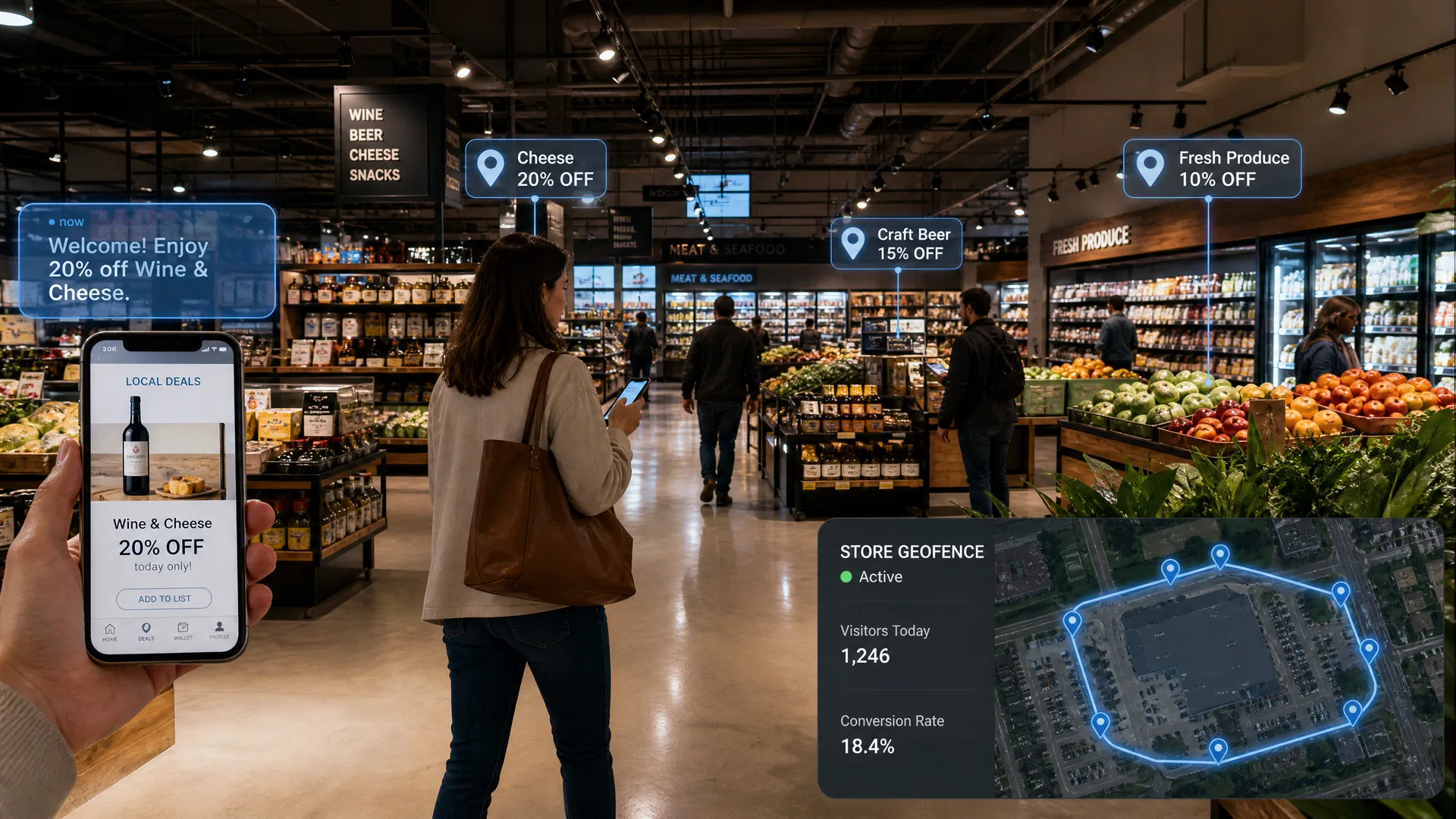

The U.S. grocery industry generates over $1 trillion in annual sales, yet the average American household shops at 2.7 different grocery stores per month, according to FMI — The Food Industry Association. That split-loyalty behavior means every grocery chain is constantly competing for share of stomach against a crowded field of national chains, regional independents, discount grocers, and specialty food retailers.
Geofencing advertising gives grocery stores a precision tool to win those undecided shopping trips. By drawing virtual boundaries around competitor store locations, parking lots, and residential neighborhoods, grocery retailers can serve targeted mobile ads to shoppers at the exact moment they are deciding where to shop.
The Grocery Geofencing Opportunity
The average American makes 1.6 grocery trips per week, spending approximately $113 per household per week on groceries (USDA Economic Research Service, 2024). A single converted shopping trip is worth $50–$150 in immediate revenue, and a converted regular shopper is worth $5,000–$8,000 in annual lifetime value. The economics of geofencing — where a cost-per-store-visit of $2–$4 is typical — make it one of the highest-ROI advertising channels available to grocery operators.
| Geofencing Strategy | Target Location | Expected Foot Traffic Lift | Best For |
|---|---|---|---|
| Competitor conquesting | Competitor parking lots | 15–25% | Winning comparison shoppers |
| Trade area targeting | Residential neighborhoods within 3 miles | 10–18% | Building habitual visit frequency |
| Lapsed customer re-engagement | Devices not seen in 60+ days | 8–15% | Win-back campaigns |
| Addressable household targeting | Specific household addresses | 12–20% | Weekly ad circular replacement |
Competitor Conquesting for Grocery Stores
The most powerful grocery geofencing strategy is competitor parking lot conquesting. When a shopper pulls into an Aldi, Kroger, Publix, or Whole Foods parking lot, they are in an active grocery-buying mindset. Serving them a targeted ad at that moment — highlighting a weekly special, a loyalty program benefit, or a price match guarantee — can redirect the trip to your store.
The retargeting window extends this opportunity significantly. A device that visited a competitor store can be retargeted for up to 30 days afterward, allowing grocery brands to build frequency and familiarity with shoppers who are currently buying from competitors. Over a 90-day campaign, a consistent retargeting message can shift habitual shopping patterns in measurable ways.
Addressable Geofencing: The Digital Circular
Traditional grocery advertising relied heavily on the weekly printed circular — a broad-reach, low-precision tool that reached every household in a zip code regardless of whether they were likely customers. Addressable geofencing replaces this model with household-level precision. By targeting specific addresses within the trade area, grocery stores can serve digital ads that function like a personalized circular — reaching households that match the demographic and behavioral profile of their best customers.
This approach is particularly effective for specialty and natural food grocers competing against conventional supermarkets. Rather than blanketing an entire zip code, an organic grocery store can target households that have demonstrated health-conscious purchasing behavior, reaching the right audience at a fraction of the cost of traditional circular advertising.
Seasonal and Promotional Campaign Activation
Holiday weeks — Thanksgiving, Christmas, Super Bowl Sunday, Memorial Day — represent disproportionate grocery revenue. Geofencing campaigns can be activated within 5–7 business days, making them ideal for time-sensitive promotional pushes. During peak holiday weeks, increasing frequency caps and expanding competitor conquesting zones to include warehouse clubs (Costco, Sam's Club) and mass merchants (Walmart, Target) captures the full competitive set that grocery shoppers consider.
For a free geofencing proposal tailored to your grocery store's trade area and competitive landscape, Mediavision2020 provides custom zone mapping and projected foot traffic lift estimates based on historical grocery campaign data.