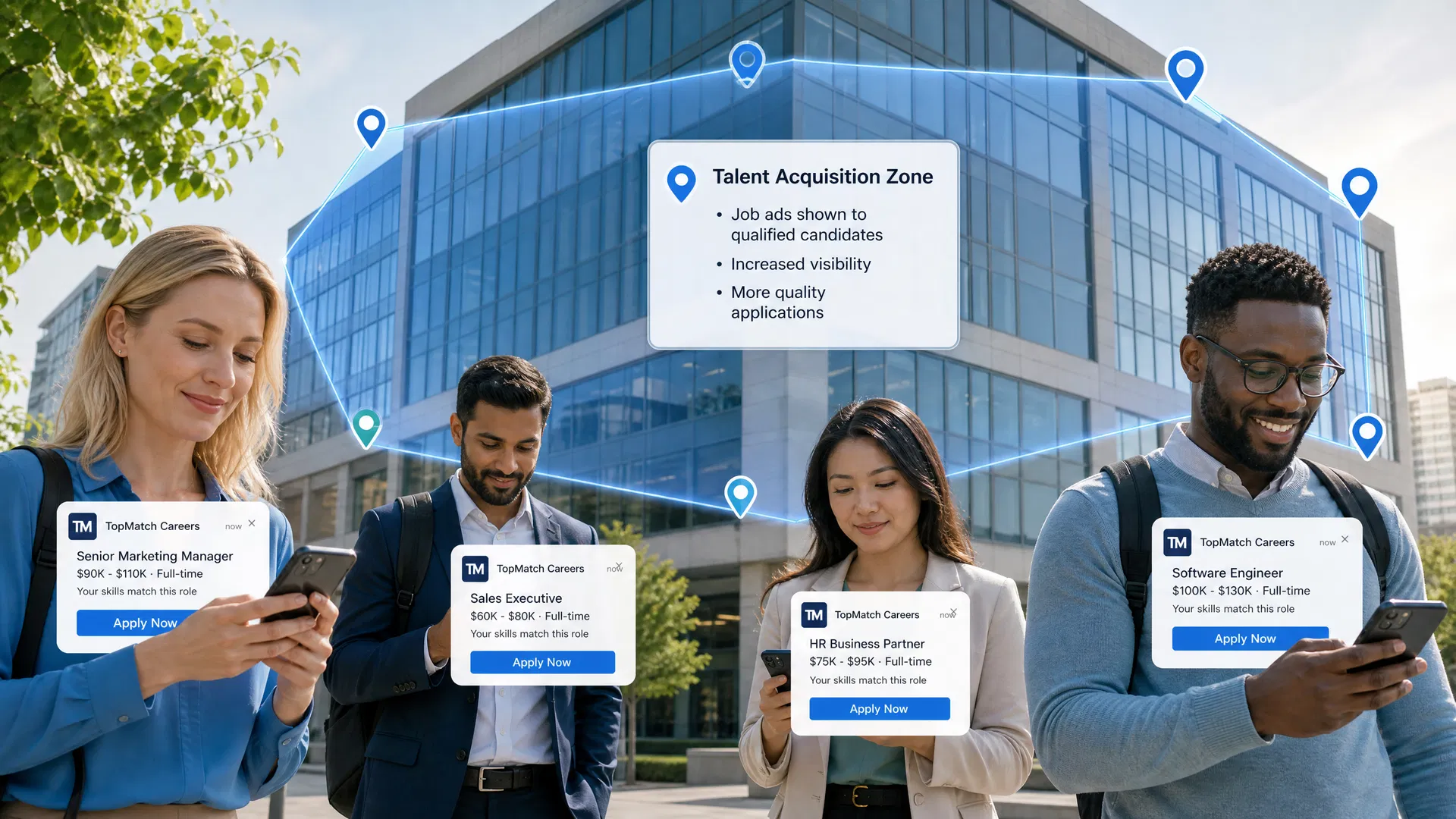
Geofencing is a game-changer for recruitment. By setting up virtual boundaries around key locations — universities, competitor offices, job fairs, and professional events — you can instantly reach local talent pools with targeted job ads.
Why Traditional Recruiting Falls Short
Job boards and LinkedIn reach active job seekers — people who are already looking. But the best candidates are often passive: they're employed, performing well, and not actively searching. Traditional recruiting tactics simply can't reach them.
Geofencing changes that equation entirely.
How geofencing Recruiting Works
Draw a virtual boundary around any location where your ideal candidates spend time:
- University campuses and career centers
- Competitor office buildings
- Industry conferences and job fairs
- Professional training facilities and certification centers
- Neighborhoods where your target demographic lives
When a candidate's mobile device enters that boundary, they become part of your target audience. You can then serve them job ads across mobile apps, mobile web, and even connected TV — reaching them at home, at work, or on the go.
The Results
Geofencing recruiting campaigns consistently outperform traditional job board advertising on cost-per-applicant and quality-of-hire metrics. By reaching passive candidates where they already are — rather than waiting for them to come to you — you dramatically expand your talent pool and reduce time-to-fill for open positions. The same precision applies beyond corporate hiring — see how charter schools are using geofencing to fill classrooms during open enrollment season.