The 2026 midterm elections are on track to be the most expensive political advertising cycle in American history — surpassing even the 2024 presidential race. According to AdImpact, total political ad spending for the 2026 cycle is projected to reach $11.6 billion, a 30% increase over the 2022 midterms and higher than the $11.2 billion spent when Trump and Harris faced off. Through June 1, 2026, campaigns had already spent $4 billion — a 46% increase over the same point in the 2024 presidential cycle.
That pace of early spending is not an accident. Campaigns are racing to lock in inventory before rising demand prices them out of key media markets. Political advertising is no longer a sprint to Election Day. It is a year-round operation, and the campaigns that understand that — and deploy precise, measurable digital tools like geofencing from the start — are the ones building insurmountable advantages before their opponents even begin.
The Digital Gap: The Biggest Strategic Opportunity in Politics Today
Despite record spending, political campaigns remain dramatically underinvested in digital relative to the commercial world. In 2024, commercial advertisers allocated 78% of their media budgets to digital. Political campaigns? Just 36%. That gap has actually widened — from 36 percentage points in 2020 to 42 in 2024. Nearly 50 cents of every dollar donated to a presidential campaign still went to TV-style ads.
The 2026 cycle is showing early signs of change, but the structural imbalance persists. AdImpact projects broadcast television will still command just under 50% of total political spend in 2026, while digital platforms (Meta, Google, Snap, X) account for an estimated 13% — actually down from 15% in 2024. CTV is the one channel showing real growth, projected at $2.6 billion in 2026, up from $2.34 billion in 2024.
For campaign managers and PAC directors, this gap is not a problem. It is an opportunity. Voters have already moved to digital. Campaigns that follow them — with precision targeting tools that broadcast television cannot match — are reaching persuadable voters their opponents are missing entirely.
Where Voters Are: The Streaming Revolution Is Complete
The data on voter media consumption is unambiguous. According to Nielsen's The Gauge report for January 2026, streaming now accounts for 47% of all television viewing in the United States. Broadcast and cable combined make up the remaining 53%, and that share shrinks every quarter. YouTube alone captures 12.5% of total television viewing — more than any single broadcast network.
This shift is not generational. Research from LG Ad Solutions confirms that 84% of US internet users now have an internet-connected TV — 84% of Democrats, 85% of Independents, and 83% of Republicans. Among those with a preference, 63% choose streaming over traditional TV. Independents, often the most sought-after voters in competitive races, show the strongest streaming preference at 70%.
The implications for political advertising are significant. A linear TV buy in a competitive DMA might reach 44% of registered voters overall — but it disproportionately reaches partisan base voters who are already locked in. Persuadable swing voters, the ones who actually decide close races, are underserved by broadcast. They are on streaming platforms, on their phones, and in apps. That is where geofencing reaches them.
Why Location Is the Most Valuable Data in Politics
Voter files tell you who someone is. Location data tells you what they do. Those are two very different things — and the difference matters enormously in a competitive race.
A registered Republican who attends a gun show, shops at a farm supply store, and worships at a rural evangelical church every Sunday is a very different persuasion target than a registered Republican who lives in a suburban zip code, commutes to a downtown office, and sends their kids to a private school. Party registration is a blunt instrument. Location history is a scalpel.
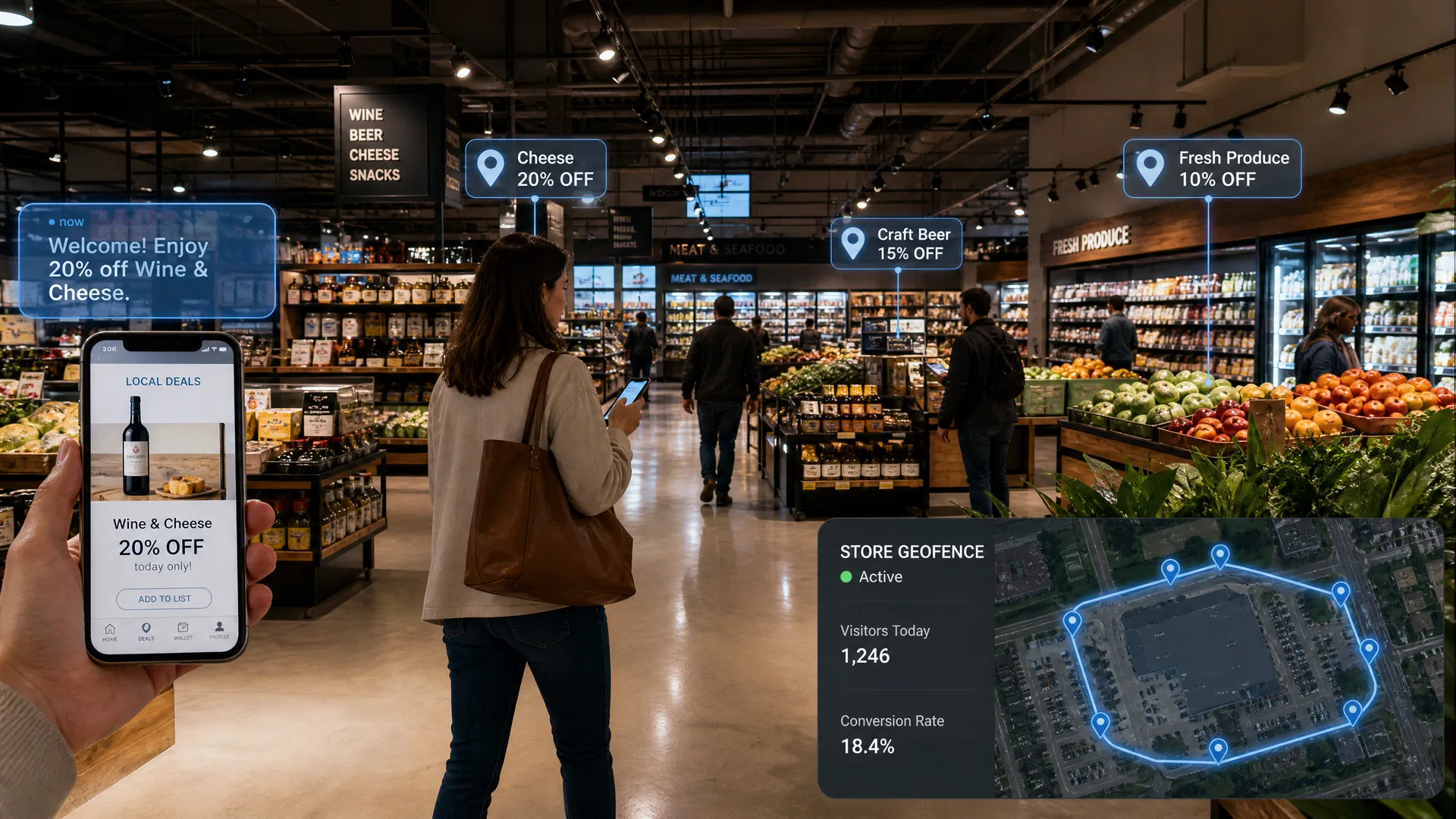
Geofencing works by drawing a virtual boundary — called a geofence — around a real-world location using GPS, Wi-Fi, or cellular data. When a mobile device enters that boundary, it becomes eligible to receive targeted digital ads across apps, mobile browsers, websites, and streaming platforms. Those ads follow the device even after it leaves the geofenced area, creating a persistent audience of people who have been physically present at locations that signal their values, interests, and political leanings.
Targeting by District: Precision Where It Counts
In a competitive congressional race, the margin of victory is often measured in hundreds of votes. Broad TV buys that blanket an entire media market are an expensive way to reach a small number of persuadable voters in the specific precincts that matter. Geofencing inverts that equation.
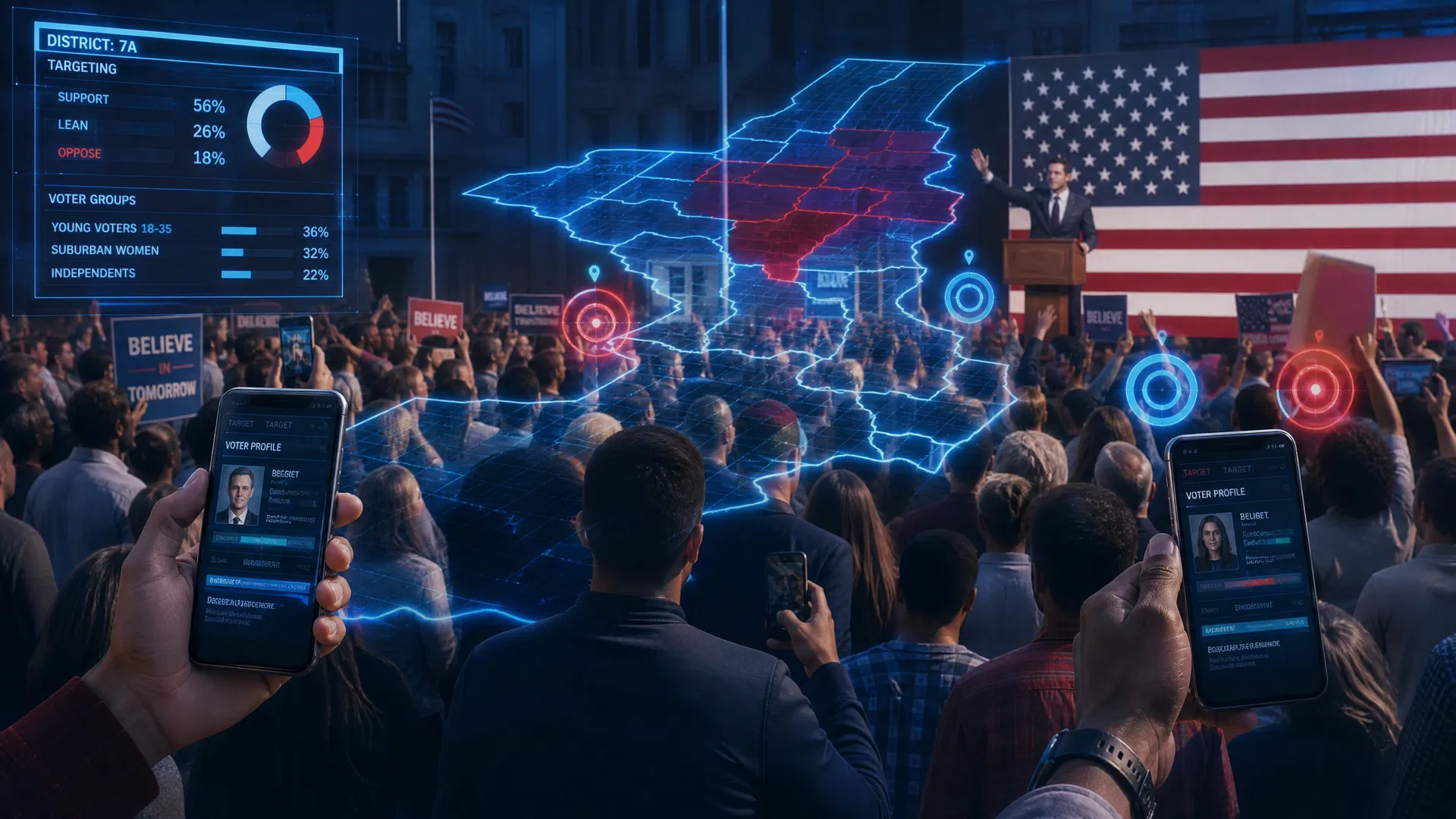
With geofencing, a campaign can draw a precise polygon around a single precinct, a specific neighborhood, or even a single apartment complex in a swing district. That precision means every ad dollar is working on the voters who actually determine the outcome — not the safe partisans on either side who have already made up their minds.
Common district-level targeting strategies include:
- Precinct-level persuasion: Geofence the highest-turnout swing precincts identified in the voter file and serve issue-based messaging to residents of those specific blocks.
- Polling location targeting: Serve get-out-the-vote reminders to voters as they approach early voting sites and Election Day polling places, with real-time CTAs like "Your polling place is open until 8 PM tonight."
- Campaign event amplification: Geofence your own rallies and town halls to capture the mobile IDs of attendees, then retarget them with follow-up messaging, donation appeals, and volunteer recruitment ads for weeks afterward.
- Opposition conquesting: Geofence your opponent's campaign events and serve contrast ads to their attendees — reaching persuadable voters who are still evaluating their options.
- Workplace and commuter targeting: Geofence major employers, transit hubs, and commuter corridors within the district to reach working-age voters during their daily routines.
The results are measurable. A state senate campaign that geofenced early voting sites and key community centers across three key precincts — serving 15-second video ads with voting reminders — saw 4.8 million impressions over 12 days, a 63% video completion rate, and a 12% increase in early voter turnout in geofenced precincts compared to control areas.
A 2025 Pennsylvania judicial campaign run by Data Trust took measurement even further. By segmenting voters based on ad exposure frequency through The Trade Desk, they found that voters exposed to 5 to 10 ads had the highest ballot return rate at 38%. Overall, voters exposed to those ads were 31% more likely to request a ballot and 25% more likely to return it. Around 38,000 new voters were reached who would otherwise have been missed.
Targeting by Political Leaning: Beyond Party Registration
Party registration data is useful, but it misses the voters who matter most: the persuadables, the low-propensity voters who lean your way but need motivation, and the soft supporters of your opponent who are open to switching. Geofencing reaches all three groups through behavioral signals that party registration cannot capture.
The principle is straightforward: where people choose to spend their time reveals what they believe. A campaign can build distinct audience segments by geofencing venues and events associated with specific political values:
- Conservative-leaning audiences: Gun shows, NRA chapter meetings, hunting and fishing expos, farm supply stores, megachurches, NASCAR events, military base perimeters, and county fairs in rural areas.
- Progressive-leaning audiences: Climate rallies, union halls, university campuses, LGBTQ+ community centers, farmers markets in urban neighborhoods, and progressive advocacy organization offices.
- Swing voter audiences: Suburban shopping centers, community college campuses, small business associations, and civic organization meetings where both sides of the aisle are present.
These location-based audiences can be layered with interest-based behavioral data — content consumption patterns, app usage, and purchase history — to create highly refined segments. A voter who has been physically present at a gun show and consumes hunting and outdoor content on their phone is a very different target than one who simply lives in a rural zip code.
The CTV Opportunity: Geofencing Meets the Living Room
Connected TV is the fastest-growing channel in political advertising, and it is where geofencing delivers its most powerful cross-device impact. AdImpact projects $2.6 billion in CTV political spending for the 2026 cycle — the only channel showing consistent growth over the 2024 presidential cycle. Platforms like Hulu, Roku, YouTube TV, and Peacock are seeing the sharpest CPM increases as political dollars flood in.
Geofencing and CTV are a natural pairing. A campaign can geofence a specific neighborhood or precinct, capture the household IP addresses of residents, and then serve 30-second video ads to those same households on their smart TVs, tablets, and laptops — all within the same programmatic campaign. In one statewide campaign, combining streaming with linear TV increased total reach among swing voters from 43% to nearly 90%. The streaming component delivered incremental reach of over 40% among targeted swing voters that the broadcast buy missed entirely.
In 2024, Democratic campaigns that activated first-party voter data through the FreeWheel Identity Network found 18-times higher match performance on CTV bid requests compared to standard targeting. That kind of identity resolution — matching voter file records to connected TV devices at the household level — is now being scaled into the 2026 cycle by both parties.
The 2026 Battleground: Where the Money Is Going
Understanding where political spending will concentrate in 2026 helps campaigns and PACs plan their geofencing strategy around the most competitive markets. According to AdImpact's updated projection:
- Senate races: Projected at $3.4 billion — with Texas, Michigan, Georgia, North Carolina, and New Hampshire among the most contested. The Texas Senate primary alone is one of the most expensive races on record.
- House races: Projected at $2.2 billion — the first time House spending will exceed $2 billion. Twelve of the 40 most competitive seats are in the New York and Los Angeles media markets.
- Gubernatorial races: Projected at $1.95 billion — with California, New Jersey, and Georgia hosting three of the four most expensive gubernatorial contests on record.
- Downballot (ballot propositions and state legislative races): Projected at $3.9 billion — 36% of all political ad spending this cycle.
The top spending states are California ($1.1 billion), Michigan ($936 million), Georgia ($757 million), North Carolina ($669 million), and Texas ($556 million). Campaigns operating in these markets should begin geofencing operations well before the traditional September-through-November window, as inventory costs will spike sharply as Election Day approaches. Historically, 50% of all political ad dollars run in the final 30 days before Election Day, with 25% concentrated in the final 10 days.
Measuring What Matters: Attribution in Political Campaigns
One of the persistent criticisms of digital political advertising is that it is hard to measure. Geofencing solves a significant part of that problem through foot traffic attribution — the ability to track whether a voter who saw your ad later showed up at a polling place, a campaign office, or a voter registration event.
Key metrics for geofencing political campaigns include:
- Impressions and reach: Total number of voters exposed to the campaign and how many unique devices were served ads within each target precinct.
- Click-through rate (CTR): Engagement rate on issue-based and GOTV ads, typically ranging from 0.10% to 0.35% for well-targeted political display campaigns.
- Video completion rate: For 15- and 30-second video ads, completion rates above 60% indicate strong message resonance with the target audience.
- Walk-in rate: The percentage of ad-exposed voters who subsequently visited a polling place, campaign office, or voter registration site — the most direct measure of mobilization impact.
- Voter file matching: Device IDs captured through geofencing can be matched back to the voter file to confirm that the campaign is reaching registered voters in the target universe.
- Ballot request and return rate: Increasingly, campaigns are matching ad exposure data to actual ballot request and return records — the ultimate proof of mobilization effectiveness.
Compliance: What Every Campaign Needs to Know
Political advertising through geofencing is subject to the same disclosure requirements as any other paid political communication. Every ad must include a "Paid for by" disclaimer identifying the campaign or committee. FEC reporting requirements apply to digital ad spend just as they do to television and direct mail.
On the data side, reputable geofencing platforms use opt-in location data collected through app permissions — not covert tracking. Campaigns should confirm that their geofencing vendor complies with applicable state privacy laws, including CCPA in California, and that location data is not retained beyond the campaign period. In 2026, AI-generated political content — including deepfake ads — is proliferating faster than platform enforcement or federal regulation. Working with a vendor that maintains strict brand safety controls and content verification is no longer optional.
The Strategic Takeaway: Start Now
The 2026 cycle is already underway. By August 2025, political advertisers had spent $900 million — 33% more than at the same point in 2023 and 58% more than in 2021. The campaigns that are winning are the ones that started building their digital audiences, testing their messaging, and establishing their geofencing infrastructure months before their opponents began. Waiting until Labor Day to launch a digital strategy is not a plan. It is a concession.
Geofencing does not replace canvassing, direct mail, or television. It makes all of them more effective by ensuring that every other touchpoint is reinforced by a consistent digital presence that follows voters wherever they go — on their phones, their tablets, and their connected TVs — based not just on who they are on paper, but on where they actually spend their time.
If you are managing a campaign, advising a PAC, or planning a ballot initiative for 2026, Mediavision2020 can build a geofencing strategy tailored to your district, your voter universe, and your budget. Contact us for a free political campaign strategy consultation.