
The RV industry is experiencing one of its most competitive eras. After the pandemic-driven surge in RV ownership, the market has normalized — and dealers are fighting harder than ever for a shrinking pool of active buyers. The dealerships winning in this environment are not the ones with the biggest TV budgets. They are the ones reaching the right buyers at the right moment with precision location-based advertising.
Geofencing advertising is uniquely suited to the RV industry because RV buyers telegraph their intent in the physical world long before they make a purchase decision. They visit competing dealerships. They attend RV shows. They camp at RV parks and browse outdoor retailers. Every one of these physical-world behaviors is a targetable signal — and competitor geofencing lets you capture it.
For a comprehensive overview of all RV dealership geofencing strategies, visit our dedicated RV Dealership Geofencing industry page.
Why Geofencing Is the Most Powerful Channel for RV Dealers
RV purchases are among the most considered buying decisions consumers make. The average RV buyer visits 2–4 dealerships, attends at least one RV show, and spends 6–12 weeks in active research before signing a purchase agreement. During that window, they are physically present at locations that reveal exactly where they are in the buying cycle.
Traditional digital advertising — search, social, display — targets audiences based on demographics, interests, and browsing behavior. Geofencing adds a physical-world layer: it targets people based on where they actually go. A shopper who walked onto a competing dealer's lot yesterday is a fundamentally different audience than someone who clicked on an RV-related article. Geofencing captures the former — the highest-intent audience available.
The 5 Core Geofencing Strategies for RV Dealerships
1. Competitor Lot Conquesting
The flagship RV dealer geofencing tactic is competitor lot conquesting. By drawing precise geofences around competing dealerships — including their lots, service lanes, and finance offices — you build an audience of shoppers who are actively in the market right now. Those devices are then served your ads across mobile apps, websites, and streaming TV for up to 30 days after their visit.
For RV dealers, this means you can intercept a shopper who just walked through a competitor's Class A inventory and serve them your ad featuring your best Class A offer within hours of their visit. The timing advantage is significant: you reach them while the purchase decision is still open and the competitive comparison is still active.
Best competitor targets: All RV dealerships within a 50-mile radius, including franchise dealers, independent lots, and consignment dealers. Include service-only facilities — customers bringing their RV in for service are often considering an upgrade.
2. RV Show and Expo Targeting
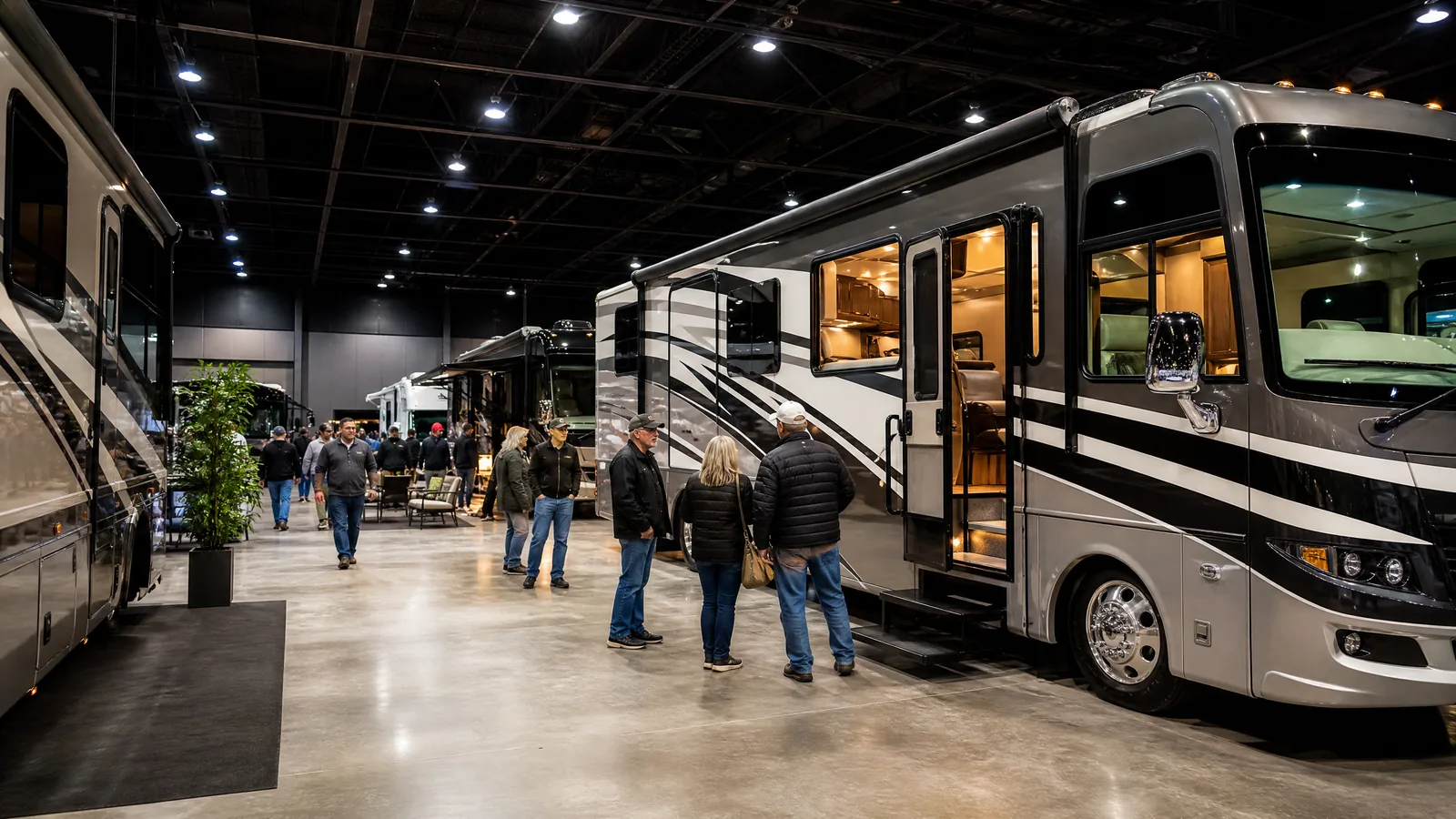
RV shows are the single highest-intent audience available to any RV dealer. Attendees at events like America's Largest RV Show in Hershey, the Florida RV SuperShow in Tampa, or any regional RVIA-affiliated show have self-selected as active RV buyers or serious enthusiasts. They have paid to attend, traveled to the venue, and are spending hours evaluating inventory.
Event geofencing lets you build audiences from any show venue and retarget those attendees for up to 30 days after the event ends. A three-day show with 50,000 attendees can generate a retargeting audience of tens of thousands of qualified buyers — all of whom have demonstrated the highest possible purchase intent by physically attending.
Timing strategy: Run pre-show awareness ads to the venue's surrounding area in the week before the event. During the show, serve competitive conquest ads to attendees in real time. Post-show, retarget the full audience with inventory-specific offers and calls to action for up to 30 days.
3. Campground and RV Park Targeting
Active campers and RV park visitors represent a lifestyle-aligned audience with high long-term purchase intent. Many are current RV owners considering an upgrade, and many are first-time campers evaluating whether RV ownership makes sense for their family. Both segments are valuable.
Addressable geofencing can target specific campgrounds, state parks with RV hookups, KOA locations, and private RV resorts within your market. This is a longer-funnel awareness play rather than a direct-response tactic, but it builds brand recall with the exact lifestyle audience most likely to become future buyers.
4. Outdoor Retailer and Lifestyle Venue Targeting
RV buyers shop at predictable locations before and after their purchase. Outdoor retailers (Camping World, Bass Pro Shops, Cabela's, REI), towing accessory shops, and RV supply stores attract audiences actively engaged in the outdoor lifestyle. Geofencing these locations builds audiences that skew heavily toward current and prospective RV owners.
This tactic is especially effective for dealers in markets without major RV shows, where competitor lots and outdoor retailers may be the only high-intent physical touchpoints available.
5. Service Lane and Finance Office Retargeting
Your own service lane is one of the most underutilized geofencing opportunities in the RV industry. Customers bringing their RV in for service are often in the early stages of considering an upgrade — especially if their unit is 5+ years old or facing a major repair. Geofencing your own service facility and serving upgrade-focused ads to those visitors can generate incremental trade-in leads from your existing customer base.
Measuring ROI: Foot Traffic Attribution for RV Dealers
One of the most common objections to digital advertising among RV dealers is the difficulty of connecting ad spend to actual lot visits and sales. Foot traffic attribution solves this problem directly.
Mediavision2020's ChattaBase dashboard tracks which devices were exposed to your geofencing ads and then physically visited your dealership. This gives you a verified cost-per-lot-visit metric — a direct measure of how efficiently your ad spend is driving physical traffic. For RV dealers with average transaction values of $40,000–$150,000, even a modest improvement in lot visit volume from geofencing campaigns produces significant revenue impact.
Typical performance benchmarks for RV dealer geofencing campaigns:
- Click-through rate: 0.25–0.40% (vs. 0.05–0.10% for standard display)
- Foot traffic lift: 15–25% increase in verified lot visits from ad-exposed audiences
- Audience retention: Up to 30 days post-visit retargeting window
- Campaign launch time: 48–72 hours from creative approval
RV Dealer Geofencing Case Study: Regional Dealer Conquests 4 Competitors
A regional RV dealer in the Southeast was losing market share to four competing dealerships within a 40-mile radius. The dealer had been relying primarily on TV and radio advertising, with no visibility into which channels were driving actual lot visits.
Mediavision2020 built geofences around all four competing lots and the two largest RV parks in the market. The 90-day campaign served display and pre-roll video ads to 28,000 unique devices. Results included a 0.33% CTR, 312 verified lot visits from ad-exposed audiences, and 14 documented sales traced to the campaign through CRM matching — producing a 9:1 return on ad spend.
Seasonal Strategy: Maximizing Geofencing ROI Throughout the Year
RV demand is seasonal, but geofencing strategy should not simply mirror that seasonality. The most effective approach is to use different geofencing tactics at different points in the buying cycle:
- Pre-season (January–March): Target RV show attendees and outdoor retailer visitors to build awareness before peak buying season. This is when buyers are researching and forming brand preferences.
- Peak season (April–August): Shift to competitor conquesting and high-intensity retargeting. Buyers are actively visiting lots and making decisions — this is when conquest ads have the highest conversion rate.
- Post-season (September–December): Target campground visitors and service lane customers for trade-in and upgrade campaigns. End-of-year inventory clearance offers perform well with audiences who visited competitor lots earlier in the year.
Getting Started: What to Expect from a Mediavision2020 RV Dealer Campaign
Every Mediavision2020 RV dealer campaign begins with a strategy session to identify your highest-value geofencing targets — competitor lots, upcoming shows, campgrounds, and outdoor retailers in your market. We then build the campaign, handle all technical setup, and launch within 48–72 hours of creative approval.
Real-time reporting through ChattaBase gives you 24/7 visibility into impressions, clicks, CTR, and foot traffic attribution from day one. There are no long-term contracts and no hidden fees — just transparent, performance-driven geofencing built specifically for the RV industry.
Ready to start conquesting competitors and filling your lot?
Also see our companion guides in the powersports vertical: Geofencing for Boat Dealers and Geofencing for Motorcycle Dealerships — the same competitor conquesting and show targeting playbook applied across the full powersports market.
Request a free RV dealer geofencing strategy session — we'll identify your best targeting opportunities and provide a transparent proposal within 24 hours.