Not all geofencing companies are the same. The technology that powers location-based advertising has become more accessible over the past decade, which means the market is now crowded with vendors ranging from enterprise platforms with sophisticated data infrastructure to resellers who have simply white-labeled someone else's technology and added a markup. For a business owner, marketing director, or campaign manager evaluating geofencing partners, the difference between a vendor who truly understands the craft and one who is simply selling impressions can mean the difference between a campaign that drives measurable results and one that burns through budget with nothing to show for it.
This guide covers the most important factors to evaluate when choosing a geofencing company — the questions to ask, the red flags to watch for, and the standards you should hold any prospective partner to before you commit a dollar of your advertising budget.
1. Depth of Tactical Knowledge: Beyond Basic Geofencing
The most important question you can ask a prospective geofencing vendor is not "how does geofencing work?" It is "what tactics do you use, and how do you decide which ones are right for my business?" A vendor who can only describe the basics — drawing a virtual fence around a location and serving ads to people who enter it — is telling you they have a hammer and see every campaign as a nail. A true geofencing expert understands that different business objectives require fundamentally different tactical approaches, and that the best campaigns layer multiple strategies together.
Here are the core tactics any serious geofencing partner should be able to discuss fluently:
Lookback Audiences
Lookback audiences — sometimes called historical geofencing or past visitor targeting — allow you to reach people who visited a specific location not just today, but over a defined window of time in the past: the last 30, 60, or 90 days. This is one of the most powerful tactics in geofencing because it lets you build audiences based on demonstrated behavior rather than assumptions. A car dealership can target everyone who visited a competitor's lot in the past month. A hospital can reach people who have been to a specialist's office. A political campaign can build an audience of everyone who attended a rival's rally over the past quarter.
If a vendor cannot clearly explain how lookback audiences work, how far back their data goes, and how they build those historical audience pools, that is a significant gap in their capability.
Behavioral Targeting
Behavioral targeting goes beyond location to incorporate how people use their devices — the apps they open, the content they consume, the searches they conduct, and the purchases they make. A sophisticated geofencing partner will layer behavioral signals on top of location data to create far more refined audience segments. Someone who has been physically present at a gym and regularly uses fitness apps and browses nutrition content is a much more precise target for a health brand than someone who simply lives near the gym.
Ask your prospective vendor how they incorporate behavioral data into their audience builds. If the answer is "we just target people in the geofenced area," you are looking at a basic platform, not a strategic partner.
Audience Targeting and Lookalike Modeling
The best geofencing companies can take your existing customer data — an email list, a CRM export, a voter file — and use it to build lookalike audiences: people who share the behavioral and location patterns of your best customers but have not yet been exposed to your brand. This capability dramatically expands your reach beyond the physical boundaries of any single geofence and allows you to find new prospects who are statistically similar to the people who already buy from you.
Audience targeting also includes demographic and psychographic layering — age, income, household composition, lifestyle interests — that allows campaigns to be refined beyond what location data alone can achieve. A geofencing partner who cannot offer this level of audience sophistication is limiting your campaign before it even launches.
Industry-Specific Tactics
Different industries require fundamentally different geofencing strategies. A healthcare provider has very different compliance requirements, audience sensitivities, and conversion goals than a quick-service restaurant or a political campaign. A geofencing partner with genuine industry expertise will know which tactics perform in your vertical, which ones to avoid, and how to structure a campaign around the specific decision-making journey of your customers.
For healthcare, that means understanding HIPAA-adjacent data sensitivities and focusing on proximity to medical facilities and competitor practices. For automotive, it means conquesting competitor dealerships and targeting service department visitors. For retail, it means event-based targeting, competitor store conquesting, and foot traffic attribution to measure in-store lift. For political campaigns, it means precinct-level precision, polling location targeting, and voter file matching.
Ask your prospective vendor for specific examples of campaigns they have run in your industry. If they cannot provide them, ask how they would approach your specific business objective. Vague answers are a red flag.
2. Years of Experience and Proven Results
Geofencing as a discipline has evolved significantly since its early days. The vendors who have been in the space since the beginning have learned lessons that cannot be taught in a product manual — they know which audience sizes produce meaningful reach without sacrificing precision, which bid strategies work in competitive markets, how to structure a campaign for a 30-day sprint versus a six-month brand awareness play, and how to read performance data to make mid-campaign optimizations that actually move the needle.
Experience also means having seen what does not work. A vendor who has only been operating for two or three years may not have encountered the full range of campaign scenarios — seasonal fluctuations, competitive market dynamics, audience fatigue, attribution challenges — that a more seasoned partner has already navigated and solved. The ability to say "we tried that approach in a similar campaign and here is why we recommend doing it differently" is worth more than any technology feature.
When evaluating experience, look for:
- Years in operation — specifically in geofencing and location-based advertising, not just digital advertising generally
- Number of campaigns managed — volume of experience matters because it accelerates pattern recognition
- Case studies with real numbers — not just testimonials, but documented results: impressions delivered, click-through rates, foot traffic lift percentages, and conversion outcomes
- Client retention rate — companies that consistently deliver results keep their clients; high turnover is a signal that campaigns are not performing
- Vertical depth — experience across multiple industries indicates a vendor who has had to adapt their approach to different business contexts, which makes them better strategic partners
3. Transparency in Pricing
Pricing opacity is one of the most common complaints about geofencing vendors, and it is a legitimate concern. Some vendors bundle their management fees, data costs, and media spend into a single opaque number that makes it impossible to understand what you are actually paying for. Others quote a low CPM but fail to disclose that a significant portion of your budget will be consumed by platform fees, data licensing costs, or minimum spend requirements that were buried in the contract.
A trustworthy geofencing partner will provide a clear, itemized breakdown of how your budget is allocated:
- Media spend — the actual cost of serving impressions to your target audience
- Data costs — fees for third-party audience data, behavioral targeting layers, or voter file matching
- Management and strategy fees — what the vendor charges for campaign setup, optimization, and reporting
- Technology fees — platform access costs, if any
- Minimum commitments — any minimum spend thresholds or contract length requirements
You should also ask how pricing scales. Does the CPM decrease as volume increases? Are there setup fees for new campaigns? What happens to unspent budget? A vendor who is reluctant to answer these questions clearly is one who benefits from your confusion — and that is not a partner you want managing your advertising dollars.
4. Transparency in Ad Placement: Know Where Your Ads Are Running
One of the most underappreciated questions in digital advertising is: where, exactly, are my ads appearing? With programmatic geofencing, your ads are served across a network of apps, mobile websites, and streaming platforms. The quality of that inventory varies enormously — from premium news apps and national streaming services to low-quality apps with minimal real user engagement.
A reputable geofencing partner will be able to tell you:
- Which supply-side platforms (SSPs) they access — the exchanges and networks through which they purchase ad inventory
- What brand safety controls are in place — how they prevent your ads from appearing next to inappropriate content or in fraudulent app environments
- Whether they use whitelists or blacklists — curated lists of approved or excluded publishers that control where your ads can and cannot run
- What percentage of impressions are served on mobile versus desktop versus connected TV — so you understand the channel mix your budget is buying
- How they handle ad fraud — what verification tools they use to filter out bot traffic and invalid impressions
If a vendor cannot or will not provide this level of placement transparency, you have no way of knowing whether your ads are reaching real people in real environments — or whether your budget is being wasted on low-quality inventory that inflates impression counts without delivering real business impact.
5. Upfront Strategy and Tactic Development
Perhaps the most important differentiator between a great geofencing partner and a mediocre one is what happens before the campaign launches. A vendor who simply takes your budget, draws some geofences around locations you suggest, and starts serving ads is not a strategic partner — they are an order taker. The campaigns that consistently outperform are the ones built on a foundation of deliberate strategic thinking before a single impression is served.
A best-in-class geofencing partner will invest meaningful time in pre-campaign strategy development, including:
- Business objective alignment — understanding whether the goal is brand awareness, foot traffic, lead generation, or direct response, and structuring the campaign architecture accordingly
- Audience architecture — defining the primary, secondary, and exclusion audiences before the campaign launches, not after it starts underperforming
- Location strategy — identifying not just the obvious geofence locations but the less obvious ones: competitor locations, feeder locations, event venues, and behavioral congregation points that your target audience frequents
- Tactic sequencing — deciding which tactics to deploy at which stages of the campaign, how they interact with each other, and how budget should be allocated across them
- Creative strategy — ensuring that ad creative is matched to the audience segment and the stage of the funnel, rather than running a single generic creative across every audience
- KPI definition — agreeing on what success looks like before the campaign starts, so there is no ambiguity about how performance will be evaluated
- Measurement plan — establishing how results will be tracked, what attribution methodology will be used, and how foot traffic lift or conversion data will be reported
If a vendor is eager to launch quickly without investing in this kind of upfront strategic work, ask yourself why. The answer is usually that they are more interested in starting the billing cycle than in building a campaign that will actually perform.
6. Reporting and Ongoing Optimization
A geofencing campaign is not a set-it-and-forget-it exercise. The best campaigns are actively managed — audiences are refined based on performance data, creative is rotated to prevent fatigue, bid strategies are adjusted in response to competitive dynamics, and budget is reallocated toward the tactics and audience segments that are delivering the strongest results.
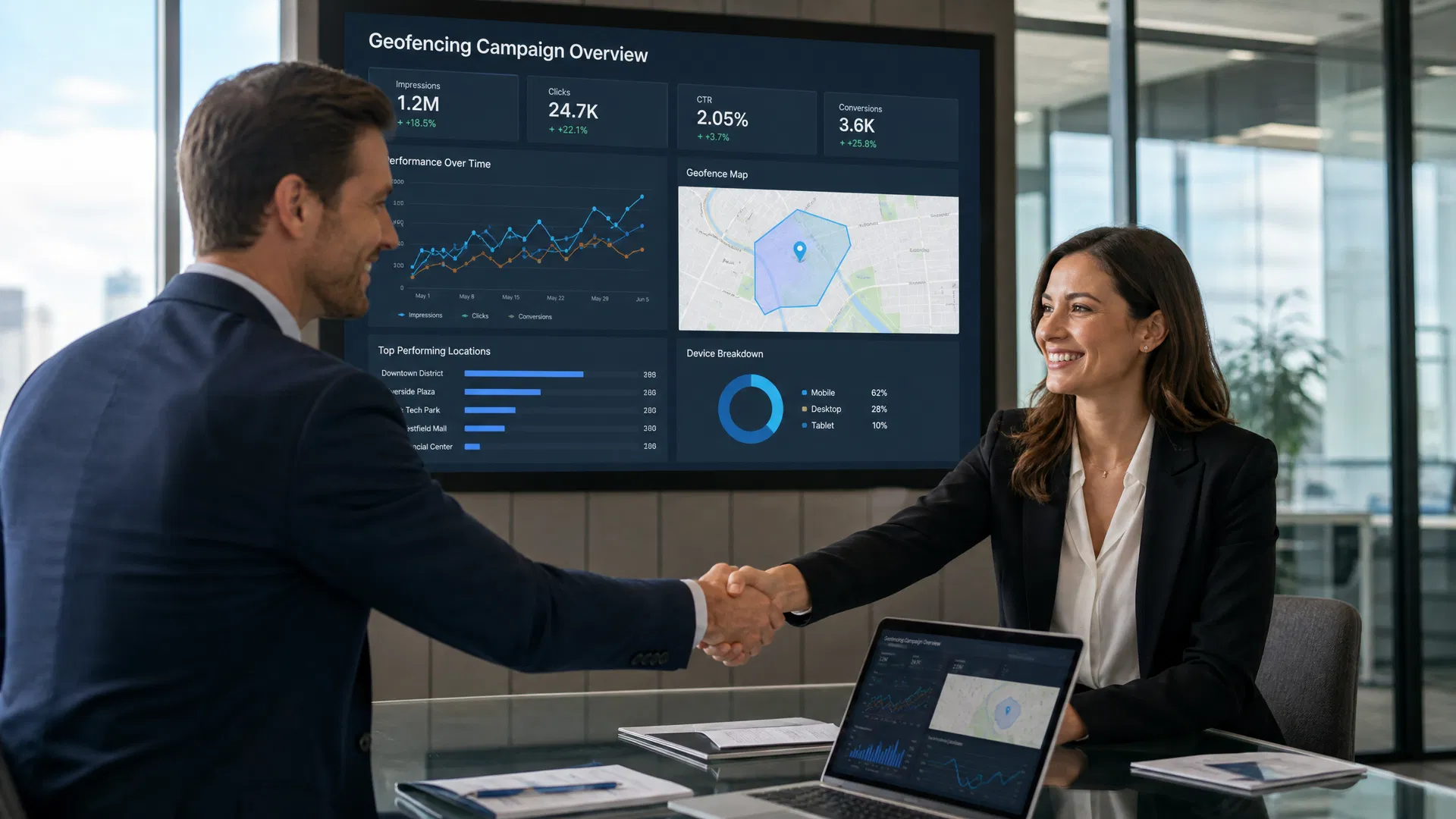
Ask your prospective vendor how frequently they optimize campaigns, what data they use to make optimization decisions, and how they communicate those decisions to you. You should receive regular reporting that includes not just vanity metrics (impressions, clicks) but the business outcomes that matter: foot traffic lift, conversion rates, foot traffic conversion rate, and return on ad spend.
Transparency in reporting is just as important as transparency in pricing. A vendor who sends you a monthly PDF with a few charts and no explanation of what the numbers mean is not a partner — they are a vendor. A true partner proactively explains what the data shows, what they are doing about it, and what they recommend for the next campaign cycle.
The Bottom Line: Choose a Partner, Not a Platform
The geofencing technology itself is increasingly commoditized. What separates the best geofencing companies from the rest is not access to a particular platform or data source — it is the strategic intelligence, industry experience, and commitment to transparency that they bring to every campaign. The right partner will challenge your assumptions, push back on tactics that are unlikely to work, and invest in understanding your business before they invest your budget.
At Mediavision2020, we have been building and managing geofencing campaigns since 2013 — longer than most of our competitors have existed. We bring deep tactical expertise across every major geofencing methodology, transparent pricing with no hidden fees, full visibility into where your ads run, and a rigorous upfront strategy process that ensures every campaign is built on a foundation of clear objectives, precise audience architecture, and measurable success criteria.
If you are evaluating geofencing partners and want to understand what a best-in-class approach looks like in practice, contact us for a free strategy consultation. We will show you exactly how we would approach your campaign — before you commit to anything.