
The retail landscape has never been more competitive. E-commerce giants have conditioned consumers to comparison-shop from their couches, big-box chains have squeezed margins on commodity goods, and rising customer acquisition costs have made broad-reach advertising increasingly inefficient. Yet brick-and-mortar retail is far from dead. According to the U.S. Census Bureau, physical stores still account for more than 85 percent of total retail sales in the United States. The challenge is not that customers have stopped shopping in stores — it is that retailers have lost the ability to reach them at the precise moment they are ready to buy.
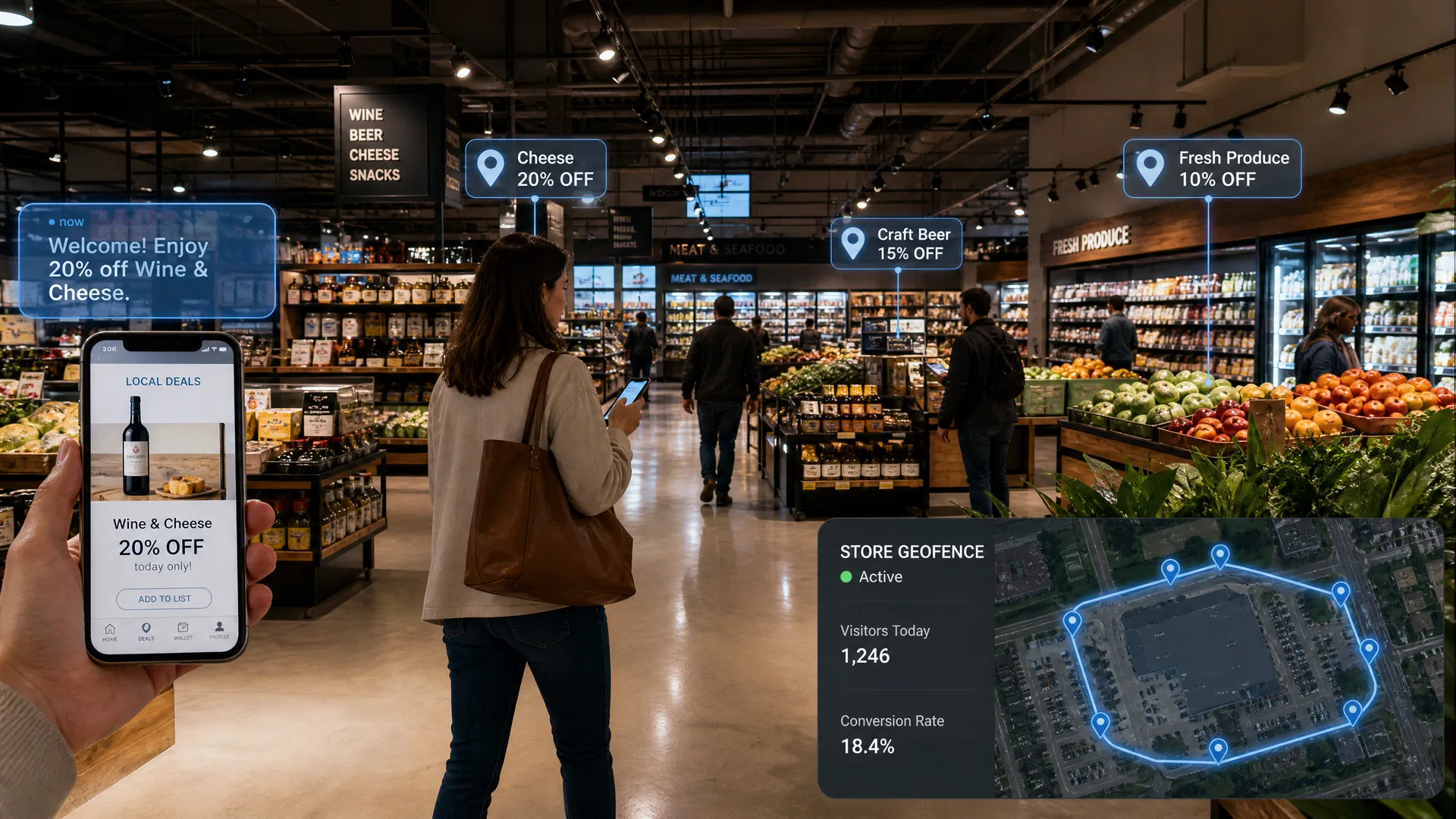
Geofencing advertising solves that problem. By drawing virtual boundaries around specific physical locations — a competitor's store, a shopping mall, a residential neighborhood — retailers can serve targeted digital ads to the exact devices that enter those boundaries. The result is hyper-local, intent-based advertising that reaches shoppers when they are in a buying mindset, not just when an algorithm guesses they might be.
What Makes Retail Geofencing Different from Traditional Digital Advertising
Most digital advertising platforms — Google, Meta, programmatic display — target audiences based on demographic data, browsing behavior, or interest signals. These are useful proxies for purchase intent, but they are proxies nonetheless. A person who searched for running shoes last week may have already bought them. A person who follows a home improvement account on Instagram may be a renter with no renovation budget.
Geofencing targets behavior, not inference. When a device enters a geofenced location — a sporting goods store, a furniture showroom, a grocery chain — that physical presence is the strongest possible signal of purchase intent. The person is not thinking about buying; they are actively in the process of buying. Reaching them at that moment, or retargeting them in the 30 days that follow, produces dramatically higher conversion rates than any demographic-based approach.
| Targeting Method | Intent Signal | Average CTR | Attribution Capability |
|---|---|---|---|
| Geofencing (competitor conquesting) | Physical presence at competitor | 0.35%–0.65% | foot traffic attribution |
| Google Display Network | Browsing/search history | 0.10%–0.20% | Click-through only |
| Facebook/Instagram Ads | Interest and demographic | 0.08%–0.15% | Click-through only |
| Traditional direct mail | Geographic proximity | 1%–5% response rate | Coupon redemption only |
The Six Core Retail Geofencing Strategies
1. Competitor Store Conquesting
Competitor conquesting is the flagship retail geofencing use case. A retailer draws a virtual fence around one or more competing store locations and serves ads to devices that enter those boundaries. The targeting can be active — serving ads while the device is inside the fence — or retargeted, following the device for up to 30 days after the visit.
The strategic logic is straightforward: a person physically inside a competitor's store is your highest-intent prospect. They have already decided to make a purchase in your category. The only question is where. Reaching them with a compelling offer — a price match guarantee, an exclusive product, a loyalty program benefit — at that exact moment can redirect the sale to your location.
For a regional furniture retailer, for example, geofencing the three nearest Ashley Furniture and Rooms To Go locations and serving a same-day delivery offer can capture customers who are comparison-shopping before committing. For a specialty running store, geofencing the nearest Dick's Sporting Goods and serving an ad for a free gait analysis can differentiate on service rather than price.
2. Mall and Shopping Center Targeting
Shopping malls and retail corridors concentrate high-intent buyers in a single physical footprint. A retailer with a mall location — or one competing with mall-based stores — can geofence the entire mall complex and serve ads to every device that enters, regardless of which anchor tenant or inline store they visit.
This strategy is particularly effective for specialty retailers competing against department store alternatives. A standalone jewelry store can geofence the nearest mall and serve ads to shoppers who entered the Macy's or Nordstrom jewelry department. A boutique clothing store can target the entire mall footprint and serve creative that emphasizes the unique, non-chain experience they offer.
3. Trade Area and Neighborhood Targeting
Not every retail geofencing campaign needs to target a competitor. Trade area targeting draws fences around the residential neighborhoods and commuter corridors that represent a store's primary customer base. According to Nielsen, 73 percent of shoppers visit stores within five miles of their home for routine purchases. Reaching those households with consistent brand messaging — especially during the week before a planned purchase — drives incremental visits that would otherwise go to the most convenient option.
Addressable geofencing takes this a step further by targeting specific household addresses rather than broad geographic zones. A home improvement retailer can target households that have recently pulled building permits. A baby goods store can target households that have recently had a child. The precision of addressable geofencing eliminates waste and ensures every impression reaches a genuinely qualified prospect.
4. Lapsed Customer Re-Engagement
Devices that visited a store 60 to 90 days ago but have not returned represent a high-value re-engagement audience. These are customers who have already demonstrated purchase intent and familiarity with the brand — they simply need a reason to return. Geofencing platforms can identify these lapsed visitor devices and serve targeted win-back campaigns with time-sensitive incentives.
The economics of re-engagement are compelling. Acquiring a new customer costs five to seven times more than retaining an existing one, according to research from Bain and Company. A lapsed customer re-engagement campaign that converts even 10 percent of the audience back into active shoppers can deliver a significantly higher return on ad spend than any new customer acquisition campaign.
5. Seasonal and Promotional Campaign Activation
Retail is inherently seasonal. Black Friday, back-to-school, Valentine's Day, Mother's Day — these concentrated shopping windows represent a disproportionate share of annual revenue for most retail categories. geofencing campaigns can be activated rapidly — most go live within five to seven business days — making them ideal for time-sensitive promotional pushes.
During peak seasons, increasing geofencing frequency caps (the number of times a single device sees an ad per day) and expanding the retargeting window (from 7 days to 30 days) maximizes reach during the critical purchase window. Pairing competitor conquesting with trade area targeting during Black Friday, for example, captures both active comparison shoppers and neighborhood residents who are in a general shopping mindset.
6. Grand Opening and New Location Campaigns
A new store location has no existing customer base and no word-of-mouth momentum. Geofencing is one of the most effective tools for generating awareness and driving first visits during the critical grand opening window. By geofencing competitor locations, nearby residential neighborhoods, and high-traffic retail corridors simultaneously, a new store can reach thousands of qualified local prospects in the weeks before and after opening day.
Grand opening campaigns benefit from a multi-format approach: mobile display ads for reach and frequency, connected TV (CTV) ads for brand awareness in the home, and streaming audio for commuter audiences. All three formats can be served to the same geofenced audience, creating a surround-sound effect that accelerates brand recognition in a new market.
Foot Traffic Attribution: Proving the ROI of Retail Geofencing
The most persistent objection to digital advertising among brick-and-mortar retailers is attribution: how do you know whether an online ad drove an in-store visit? Geofencing solves this problem directly. Because the technology tracks device location, it can measure not only which devices were served an ad but also which of those devices subsequently visited the advertised store location.
This foot traffic attribution methodology produces a verified cost-per-store-visit metric — arguably the most meaningful KPI in retail advertising. If a campaign serves 500,000 impressions, drives 2,500 attributed store visits, and costs $5,000, the cost per store visit is $2.00. That figure can be compared directly against the average transaction value and gross margin to calculate a true return on ad spend.
| Retail Category | Avg. Foot Traffic Lift | Typical Cost Per Store Visit | Best Geofencing Strategy |
|---|---|---|---|
| Specialty Apparel | 18%–28% | $3–$6 | Competitor conquesting + mall targeting |
| Home Furnishings | 22%–35% | $4–$8 | Trade area + competitor showrooms |
| Sporting Goods | 15%–25% | $3–$5 | Competitor conquesting + event targeting |
| Grocery / Specialty Food | 12%–20% | $2–$4 | Trade area + competitor stores |
| Electronics / Tech | 20%–30% | $5–$9 | Competitor conquesting + mall targeting |
| Auto Parts / Service | 25%–40% | $4–$7 | Competitor locations + residential |
Creative Best Practices for Retail Geofencing Ads
Geofencing delivers the audience; creative delivers the conversion. The most effective retail geofencing ads share three characteristics. First, they are locally relevant — referencing the specific store location, a nearby landmark, or a local promotion rather than generic national creative. Second, they include a clear, time-sensitive call to action — a same-day offer, a limited-quantity promotion, or a grand opening discount creates urgency that generic brand ads do not. Third, they are mobile-optimized — since geofencing primarily reaches devices on mobile, ads should be designed for small screens with large text, minimal copy, and a single tap-to-action button.
For competitor conquesting campaigns specifically, the creative should acknowledge the competitive context without being overtly aggressive. Messaging that emphasizes a unique differentiator — better selection, faster service, price matching, a loyalty program — tends to outperform direct comparative claims, which can feel adversarial and reduce brand trust.
Getting Started with Retail Geofencing
A retail geofencing campaign requires three inputs: a defined target geography (competitor locations, trade area boundaries, or specific addresses), a campaign budget (starting at $1,500 per month), and creative assets (banner ads in standard IAB sizes). The entire setup process — from signed proposal to live campaign — typically takes five to seven business days.
The most important first step is defining the right geofencing strategy for your specific retail category and competitive situation. A specialty retailer in a category dominated by one or two national chains has a different opportunity than a grocery store competing against a dozen neighborhood alternatives. A free geofencing proposal from Mediavision2020 includes a custom trade area map, competitor targeting zone recommendations, and projected foot traffic lift estimates based on historical campaign data in your category.
For retailers ready to move beyond broad digital advertising and into precision location-based marketing, geofencing represents one of the highest-ROI channels available. The combination of intent-based targeting, measurable foot traffic attribution, and flexible campaign structures makes it uniquely suited to the economics of brick-and-mortar retail — where every incremental store visit has a calculable value.